This is really a remarkable book for how much knowledge and information it condenses. The editing and writing are quite wonderful as most subtopics are distilled down to two pages in which the writing manages to convey historical context, relevant examples, and entertaining explanation.
It's divided into 6 books by main topics: Euphonics, Grammar, Poetic Meter & Form, Logic, Rhetoric, and Ethics. Despite not really being interested in the euphonics section and always finding grammar to be a slightly dry read even in the hands of the masterful, I'm still giving this five stars. You get a sense for the writing from such passages as this:
“The sentence is the largest unit of grammar. It is often defined as the expression of a complete thought, although one person’s complete thought may not be another’s. Perhaps the simplest way to define sentence is to say that it is a meaningful string of words with a capital letter at the beginning and a stop of some kind at the end.â€I've read at least a couple books on poetry, was an undergraduate major in English, and minored in creative writing, and this is both the most enjoyable and the most informative explanation I've ever come across in terms of conveying formal poetic terms and rhyme schemes/meter.
The logic and rhetoric sections were delightful:
“While reason enables us to plan for the future, understand the past, and engage successfully with the present, logic is interested in the laws by which reason operates. Logicians want to know what makes one argument valid, and another plain wrong. This can be very useful, because people do not always think or speak the truth: they can be in error, they can lie, and they can ‘rationalize’ in crooked ways.â€
And the book is sprinkled with entertaining anecdotes and samples ranging from the classic to the humorously current (for an example of antimetabole--a close relative of chiasmus in which reverse-order repetition of words is used--the book uses a Snoop Dogg quote: With my mind on my money and my money on my mind.).
The rhetoric section has good advice/warnings:
“Style begins to suffer the minute it takes itself too seriously. When rhetoric omits the other canons, trusting only in style, it gives up persuasion. The minute style is everything, style is nothing: it becomes mere ornament, often kitsch.
And parts of it were all too relevant to current U.S. political dynamics and what passes as discourse these days:
“... epideictic rhetoric is all about advertising, (self-)display, praise and blame, about the values ‘we’ share and others do not. It is the species of rhetoric that ‘tribal talk’ is done in, as one author put it. It is also the most myopic kind of rhetoric, which never strays far from the present (‘I’m loving it’), even when invoking the future (‘The future is bright. The future is Orange.’). It shuns reasons in favour of character and emotional appeals. Argument shrinks to slogan, as copy pushes out humanistic copia. Total advertising’s allure with its restricted and constricting rhetoric, is that is has one very simple answer---consumption---to all the complex issues of our world. That is also its fatal flaw.â€
Ethics feels like it is a topic sorely needed as we don't often pause to think about these questions and much of the emphasis on education seems to be job/profession-based as opposed to dealing with both how to think critically and what it means to live a good life.
“To be ethical is to have formed one’s life in such a way that, through deliberate excellent actions, one has confirmed and consolidated those qualities of character and intellect that make for a worthwhile and beautiful human existence.â€
“Problems arise when ethics is conceived only in terms of rules. Life is complex, so no set of rules can be specific enough to cover every circumstance. A rule-based approach tends to encourage searching for loopholes and “gaming the systemâ€. Rules can conflict, and often require interpretation. If ethics is nothing but rules, then further rules will be needed to decide what to do when rules and interpretations conflict. Such problems show why it can be seen as better to understand ethics as having to do, first and foremost, with character. Actions shape character, including the action of following good rules.â€
“Socrates discovered only what is available to every reflective adult: the quest for authentic self-understanding involves acknowledging one’s limitations.â€
For all its classical references and appealing latin or greek phrases, the book also presents snapshots of where current studies/academics have taken us...
“Psychologist Martin Seligman identifies five elements crucial for human well-being: ‘P is positive emotion, E is engagement, R is relationships, M is meaning and A is accomplishment. Those are the five elements of what free people choose to do. Pretty much everything else is in service of one or more of these goals.’
Even the appendices are interesting, starting off with many pages of proverbs.
“A proverb’s frequent purpose is to make people pause for a moment and reflect. In Gaelic-speaking Ireland, for example, a fight caused by a bad comment might be stopped with It’s often that man’s mouth broke his nose.â€
And more noteworthy anecdotes:
“Shakespeare gave more proverbs to the English than anyone else and often used John Heywood’s Dialogue Conteinyng The Nomber In Effect Of All The Proverbes In the Englishe Tongue Of 1546 as a source, lifting from it such lines as All’s well that ends well.â€
This book worked for me as it made me think, learn, and want to read/learn more. Also, there's something really satisfying about the orderly arrangement of knowledge and learning terminology for techniques and activities used throughout so much human history.
--------------------------------
Some other favorite international proverbs in the appendix:
- Even the stupidest person seems wise if he keeps his mouth shut.
- A wise man sits over the hole in his own carpet.
- If you advise a bear you deserve your fate.
- No enemy is worse than bad advice.
- Four things do not return: spoken words, flighted arrows, past life, and lost opportunities.
----------------------------
SOME OF THE CHOICE NEW WORDS/CONCEPTS I PICKED UP WHILE READING
polyptoton | chiasmus | Sorites Paradox | epicheireme | catachresis (see also, hotel manager at Balbec in the late 1800s) | litotes | dysphemism | procatalepsis | epizeuxis | bdelygmia | soraismus | paremiologist | apophthegm | autotelic
----------------------------
A similar example of Aristotle's list of virtuous traits is included in this book. 9781632864963 This is a marvelous book which baffles me with some design decisions.
Most of all the section of logic uses a mixture of fonts which I abhor. I understand that the aim was to highlight various fallacies; however, I do not see why a Trivium book should contain a horror-like dripping font. Nevertheless, this is the beauty of this book. The Trivium combines separate books and thus styles. Sometimes, still, this can leave a feeling of mess.
In general, these styles match the topic well. To my surprise, I enjoyed the most the section of poetry which opened my eyes to many enticing poems and forms. 1632864967
History-based content, well-organized references, and historic quotations used as examples have formed an interesting and beautiful consulting book.
There are some exceptions to the general compliment above. For example, some vulgar cartoons are among the first pages.
English The inside game of any serious writing is all here. This is a book for people who love words and are interested in how they work and how they interact with each other. It adds depth and meaning to all the things somebody once tried to teach me a long time ago. Sounds and rhythms and meaning and all the vocabulary to talk about how to talk about wordcraft are spelled out in an easy to read and beautifully fashioned hardcover. 416
The Trivium is the three-subject path through the Liberal Arts if Grammar, Logic, and Rhetoric (as opposed to the four-fold path of The Quadrivium: Arithmetic, Music, Geometry, and Cosmology). The Trivium is thought-based (rather than content-based) and hopes to lead to the Liberal Arts gold standard of learning how to learn.
The subjects are broken down into bite-sized histories, anecdotes, and outlines, full of demonstrated quotations and backgrounds. It’s a lot of fun to read, and stands shoulder to shoulder with the more visual The Quadrivium, which I read last year. Trivium: The Classical Liberal Arts of Grammar, Logic, Rhetoric
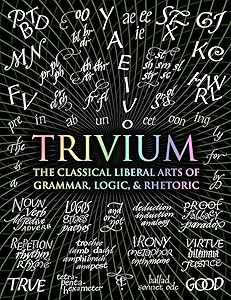
Following the success of Quadrivium, Sciencia, and Designa, Trivium combines six small books on the classical subjects of a liberal education.
The trivium refers to the three liberal arts considered in classical Greece to be the pillars of critical thought: grammar, logic, and rhetoric. Following on the success of Quadrivium and Sciencia, Trivium gathers six Wooden Books titles together into a beautiful six-color package that presents ancient wisdom in an accessible way. Trivium includes the books Euphonics, Grammar, Logic, Rhetoric,, Poetic Meter and Form, and Ethics. Trivium: The Classical Liberal Arts of Grammar, Logic, Rhetoric
I find this book to be a fantastic compendium of the linguistics arts. I hoped I would have had this book when I was in college as it summarises in a great way linguistic matters and it would have come in handy. Hardcover Really fun collection of books. Some questionable examples chosen. Trivium: The Classical Liberal Arts of Grammar, Logic, Rhetoric This is a kind of anthology. John Michell wrote the first section. Others wrote the rest. English An excellent book, but would have loved to have had some exercises/examples in there.
it's worth getting. John Michell I won't go back to this. Renaissance art history is much more interesting. John Michell
Komentar
Posting Komentar